Scaling Member Digital Shopping
Humana embarked on an initiative to cater its digital shopping experience to its current customers. Previously, Members needed to use the same digital shopping experience as new-to-Humana shoppers, leading to friction.
Upon a successful pilot–and with the enterprise decision to move more sales to owned digital channels–our goal was to scale this dedicated experience to the entire footprint, becoming available for millions of customers.
Industry: Medicare
Type: Sales - B2C
Project Type: Service definition, Implementation Orchestration
Horizon line: Near-term
Teaming: 1 service designer + 1 researcher. Supported by one Principal Service designer when needed.
Role: Service Design Lead

Key Activities
The cornerstone of the pilot experience was a machine learning model that generates intelligent plan recommendations based on a member’s Medicare details and their ZIP code. As the service designer on the team, I partnered with the Product Manager, and other stakeholders to define a scaled experience that could feasibly be implemented within the PI Planning cycles leading up to the Medicare Annual Enrollment Period (AEP). The most significant evolution to the pilot experience, in addition to the updated recommendation model, was the intent to move to a secure authentication experience, allowing for more personalization features in the digital experience.
Setting the foundation:
Identifying key journey pathways
Defining key service components and a plan of action
Facilitating secure authentication capabilities:
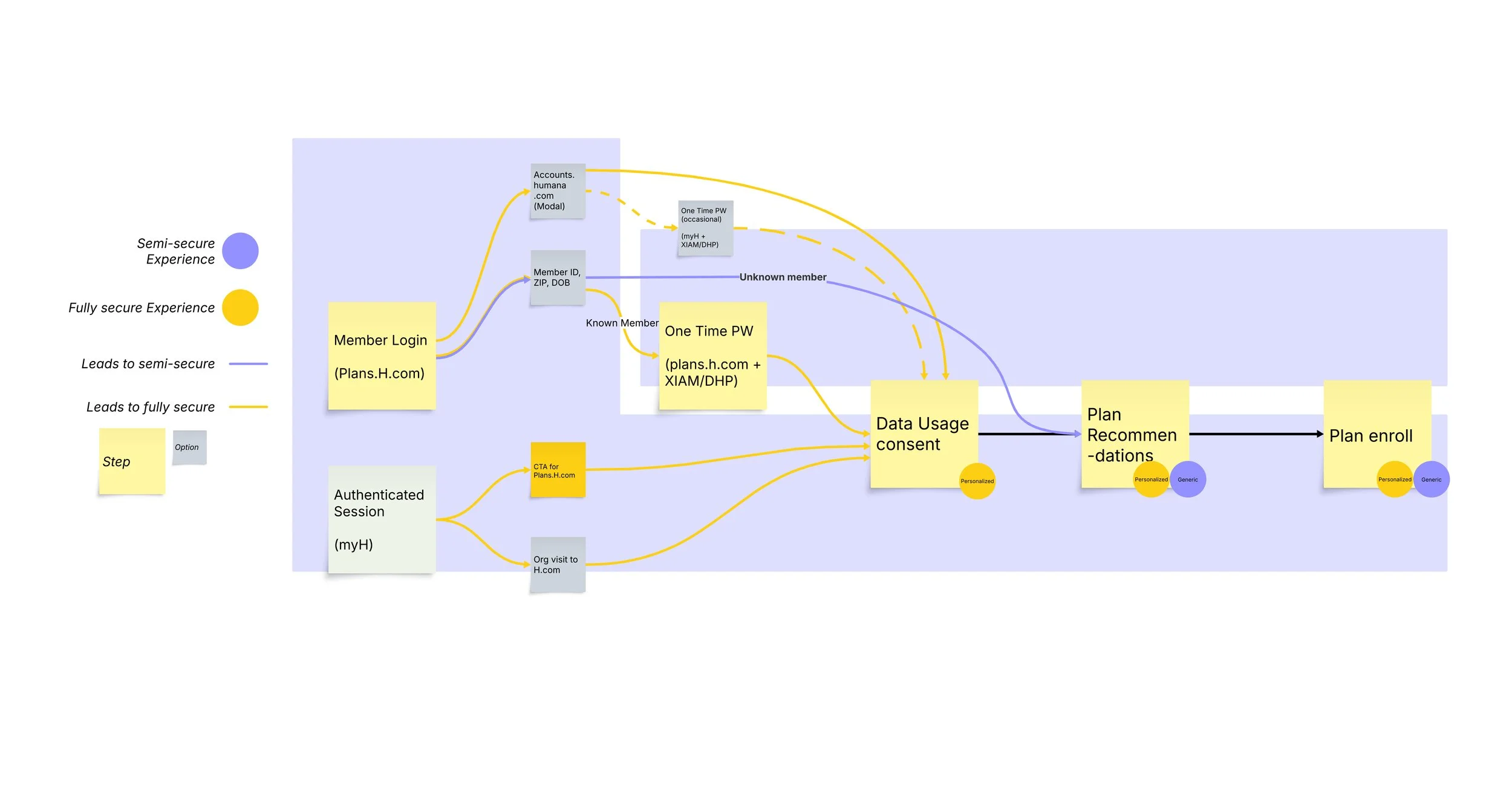
Identifying key authentication pathways
Coordinate with designers, architects, product managers, and engineers to ensure authentication matches the intended experience (via maps and wireframes).
Defining the (feasible & near-term) personalized experience:
Cross-functional hypothesis workshop to identify opportunities and define personalization concepts based on existing insights and tacit knowledge.
Develop and conduct qualitative research to evaluate concepts in partnership with the researcher.
Concept refinement, prioritization (based on desirability and effort), and right-sizing
Defining a measurement strategy:
Collaborate with data science and business intelligence partners to co-develop a measurement strategy to measure the service end-to-end, across channels, and track digital OKRs and KPIs that the Digital Sales team is responsible for.
Develop and coach partners on a multi-altitude conceptual measurement framework grounded in the member journey.
Outcomes
Facilitated the development of a fully-authenticated simple MFA login capabilities for members on the digital shopping experience–a first for Humana.
Designed a personalized digital experience that leverages member data, pre-filling doctor and drug preferences, and pre-filling enrollment forms that is feasible to build within the annual development cycle.
Identified opportunities for longer-term evolution of the service, and opportunities for omnichannel shopping.
Developed a measurement strategy and framework that served as the foundation for measuring service KPIs that ladder up to organizational KPIs. The measurement framework has become foundational for the data science teams’ measurement of digital shopping.
Results
Multiple authentication pathways resulted in a 7.2% conversion rate for Members
Auto-fill led to a 7% increase in enrollment submission
Member Plan recommendation engine scaled to all Internal Agents
Work Snapshots
Member Moments:
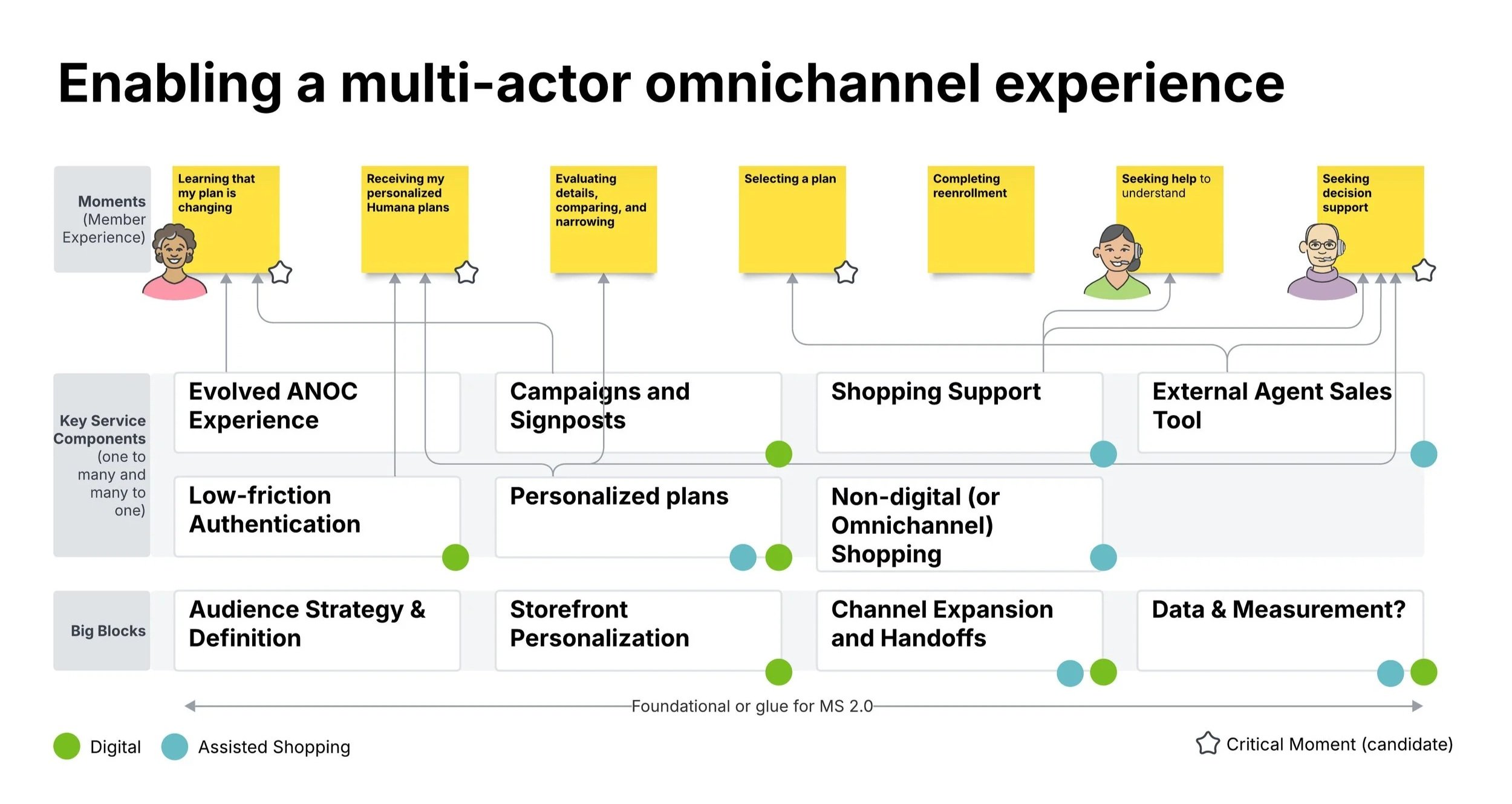
One of the first steps was to create a current state journey map of the plan shopping experience based on existing blueprints from the pilot, using “moment architecture” as an organizing framework
Key Service Components:
Introduced the notion of service components to identify key building blocks that needed to be prioritized to implement and deliver the scaled service. Each component became a trackable body of work that was then used to manage the orchestration of the experience.
Authentication:
A cross-functional team of stakeholders from Product, Customer Identity Access and Management, and Software Architecture was brought together to define the fully authenticated login experience. Multiple pathways were identified, accounting for various entry and exit scenarios. This map served as a tool for driving clarity for further definition and implementation work.